1 in 4 Children
About one in four children under age 21 lived with one parent while the other parent lived outside the household in 2022.
Source: U.S. Census Bureau
A balanced view
Balance · Safety · Records
Not every family court experience is negative. In many cases, family court provides structure, accountability, parenting plans, protective orders, mediation, and a legal path forward when parents cannot resolve issues on their own. Many families are able to reach workable agreements, and many court professionals genuinely work to protect children's best interests.
But when the system fails, the damage can be life-altering.
For some families, custody litigation becomes more than a legal dispute — it becomes a long-term emotional, financial, and psychological battle. Parents may feel unheard, children may be placed in unsafe or unstable environments, and important patterns may be overlooked because the documentation is scattered, emotional, incomplete, or difficult to review.
Rock & Refuge exists for the families who need help bringing order, clarity, and structure to the chaos.
Process
Record the event
Capture the date, time, and observable facts in plain language.
Organize by date and category
Sort entries onto a timeline so patterns become visible at a glance.
Summarize patterns clearly
Produce a court-conscious report that reads as steady, factual, and child-focused.
Statistics callout
1 in 4 Children
About one in four children under age 21 lived with one parent while the other parent lived outside the household in 2022.
Source: U.S. Census Bureau
Fathers Are Often the Non-Custodial Parent
National child-support data shows that mothers make up the majority of custodial parents. Many fathers experience custody litigation as an uphill battle when trying to increase parenting time or raise safety concerns.
Source: U.S. Census Bureau
1 in 15 Children
Approximately 1 in 15 children is exposed to domestic violence each year.
Source: Federal family-violence findings
30% to 60% Overlap
Intimate partner violence and child abuse overlap in the same families at rates between 30% and 60%.
Source: Federal family-violence findings
Safety Must Be Central
A child's physical, emotional, and psychological safety is always part of the child's best interest. Custody decisions should focus on safety, stability, and the child's lived experience.
Source: NCJFCJ child-safety guidance
Subsection
Many fathers enter family court feeling they must prove their daily involvement, consistency, and emotional connection with their child — even when they have been actively present. Some fathers face assumptions that they are secondary parents, less involved, or less prepared to provide daily care. Others are trying to document serious concerns such as missed medical care, unsafe environments, interference with parenting time, emotional manipulation, or repeated violations of the parenting plan.
Rock & Refuge does not approach custody from the belief that one parent is always right or one parent is always wrong. Instead, the focus is on documentation, patterns, child-centered facts, and organized records. A parent who is consistently showing up, documenting concerns, maintaining appropriate communication, and focusing on the child's needs should have a way to clearly show that pattern.
Subsection
One of the most painful realities in family court is that some children are returned to homes or placed in parenting arrangements where abuse, neglect, coercive control, or emotional harm may still be present. These cases are especially devastating because the child may be too young, afraid, pressured, or confused to explain what is happening.
Research and federal policy discussions have raised concerns that abuse allegations are sometimes minimized, misunderstood, or reframed as parental conflict. In some custody cases, the parent raising safety concerns may struggle to be believed, especially when the case is labeled as "high-conflict" instead of being carefully assessed for possible abuse, coercive control, neglect, or child-safety risks.
This is why organized documentation matters. Clear records can help show patterns over time, including:
Subsection
When family court gets it right, children can gain stability, safety, structure, and meaningful relationships with safe parents. But when family court gets it wrong, the consequences can be detrimental to everyone involved — especially the children.
Children may experience
Parents may experience
Our belief
Rock & Refuge believes documentation should protect the child, not punish the other parent.
The goal is not to create conflict. The goal is to organize facts, identify patterns, reduce emotional wording, and help parents communicate concerns in a way that is clear, professional, and child-centered.
Important note
Rock & Refuge Family Court Consulting does not claim that all courts, judges, GALs, attorneys, mothers, or fathers act unfairly. Every family is different. This website provides educational and documentation support only. It does not provide legal advice, therapy, custody evaluations, forensic evaluations, or court representation. Parents should consult a licensed attorney for legal advice and a licensed mental health professional for clinical concerns.
Educational resource
High-conflict family court situations can affect time, cost, emotional stress, documentation, and child well-being. This visual overview is provided for educational and resource-sharing purposes only.
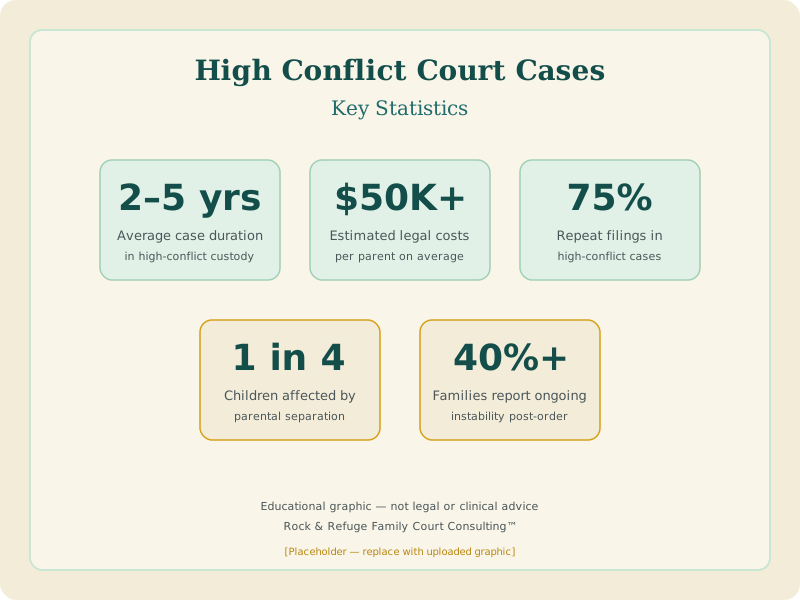
A visual overview of how high-conflict family court matters may affect time, cost, repeat filings, children, and family stability.
This graphic is provided for general educational purposes only. Every family-court matter is fact-specific. Rock & Refuge Family Court Consulting™ does not provide legal advice, therapy, custody evaluations, forensic evaluations, mediation, or court representation.
Mindset & documentation clarity
High-conflict custody cases can bring out fear, anger, grief, and emotional exhaustion in even the strongest parents. A parent may have valid concerns, real documentation, and a deep desire to protect their child — but if everything is presented through panic, rage, long emotional messages, or scattered records, the seriousness of the concerns can become harder for professionals to understand.
Rock & Refuge is not therapy, legal representation, or a counseling cure. It is educational and documentation-based support designed to help parents slow down, organize their thoughts, and approach custody-related documentation with more clarity, control, and strategy.
The goal is not to silence a parent's emotions. The goal is to help the parent avoid letting emotion control the record.
In family court, how something is documented can matter almost as much as what happened. A parent who appears organized, factual, child-centered, and emotionally regulated is often easier for attorneys, GALs, mediators, and court professionals to understand.
Rock & Refuge helps parents move from emotional reaction into organized, child-centered advocacy by slowing down the record, clarifying the facts, and focusing on what can be clearly documented.
This shift helps parents protect their credibility while keeping the focus on dates, patterns, child impact, and documentation that can be reviewed clearly.
Good parents can lose credibility when their case becomes buried in chaos.
Rock & Refuge helps parents organize the record, calm the presentation, and focus on what matters most: the child's safety, stability, and well-being.
Mindset
A custody case is not only about what a parent feels. It is also about what can be clearly shown, organized, and explained. Parents navigating high-conflict situations often need support learning how to pause, document facts, recognize patterns, and communicate in a way that protects their credibility.
Rock & Refuge encourages parents to ask:
This mindset shift can help parents move from emotional survival mode into organized advocacy.
Important disclaimer
Rock & Refuge does not provide therapy, mental health treatment, legal advice, custody evaluations, forensic evaluations, or court representation. Services are educational, organizational, and documentation-focused. Parents experiencing trauma, crisis, or emotional distress should seek support from a licensed mental health professional. Parents needing legal advice should consult a licensed attorney.
Documentation examples
Small changes in wording can make documentation clearer, calmer, and easier for professionals to review. The goal is not to erase emotion, but to separate facts from conclusions.
Reactive
"They never let me talk to my child."
Neutral
"Scheduled call was set for 7:00 PM. The call did not occur. I sent one follow-up message at 7:15 PM and did not receive a response by 8:00 PM."
Why this is stronger: Focuses on the scheduled time, what happened, the follow-up, and the lack of response without using labels or conclusions.
Reactive
"They are always irresponsible and do this on purpose."
Neutral
"Exchange was scheduled for 5:30 PM at the agreed location. The child arrived at 6:05 PM. I documented the arrival time and sent a brief message confirming the delay."
Why this is stronger: Documents the time difference and keeps the wording factual instead of assigning motive.
Reactive
"They are harassing me and trying to start a fight."
Neutral
"Message received at 8:42 PM included repeated insults and threats to withhold parenting time. I did not respond emotionally and saved the message for documentation."
Why this is stronger: Identifies the communication concern while keeping the record calm, specific, and professional.
Closing note
These examples are for documentation education only. They are not legal advice and do not decide what evidence is admissible or how a court will view a record.